
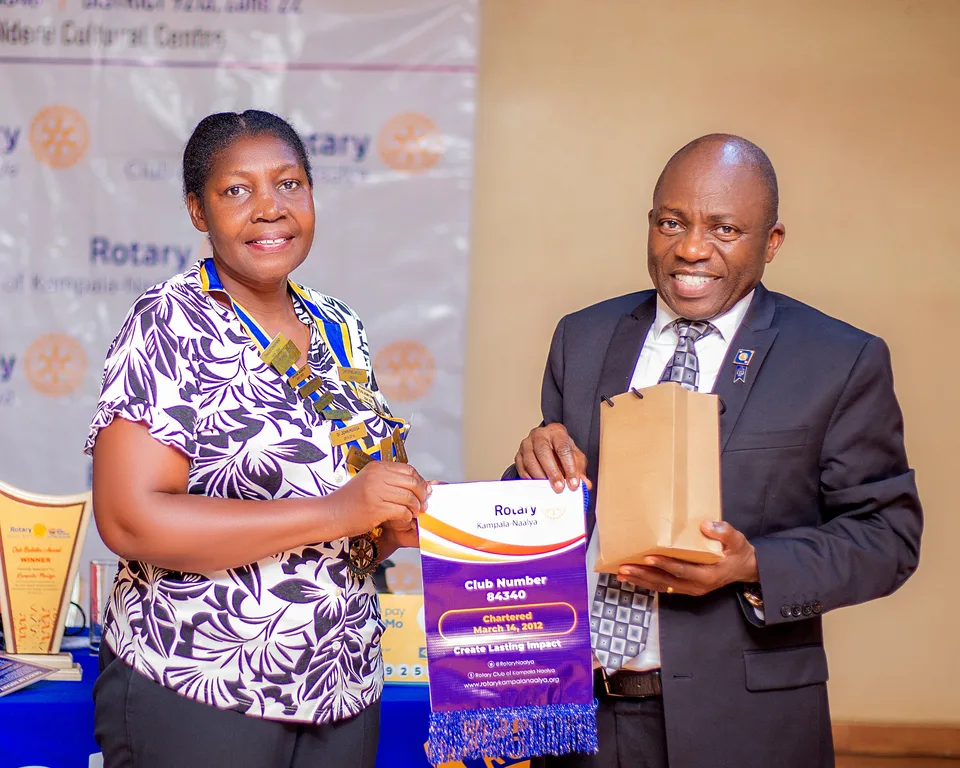
Past District Governor (PDG) Stephen Mwanje has called on members of the Rotary Club of Kampala Naalya to strengthen their support for The Rotary Foundation (TRF), saying increased contributions and participation are essential to expanding Rotary's impact on communities.
Speaking during a fellowship at Ndere Cultural Centre on November 10, 2026, under the theme “The Power of Us: Turning Ordinary Giving into Extraordinary Change,” PDG Stephen challenged Rotarians to embrace a stronger culture of giving, innovation and accountability to enable the Foundation to respond to growing community needs.
He emphasised that supporting The Rotary Foundation should not be viewed merely as a financial obligation but as an opportunity for Rotarians to participate in sustainable initiatives that improve lives.
“We need to give back to the community. It is simply the right thing to do,” was among the central arguments in his presentation, which outlined both the moral and practical reasons for supporting the Foundation.
Mwanje also challenged members to recognise that giving has benefits beyond the immediate communities receiving assistance. According to his presentation, supporting the Foundation makes business sense, creates opportunities for collective impact and gives donors the satisfaction of knowing that their contributions are changing lives.
He further observed that difficult economic conditions make charitable giving even more important, as vulnerable communities are likely to face greater challenges during periods of economic hardship.
PDG Stephen traced The Rotary Foundation's history to 1917, when Rotary International President Arch Klumph proposed establishing an endowment to support Rotary's humanitarian work. Klumph argued that Rotary, having established itself as a community service organisation, should accept endowments to enable it to do good in the world.
The Foundation's journey began with a contribution of $26.50 from the Rotary Club of Kansas City, Missouri. Over the decades, it evolved into a major vehicle for Rotary's humanitarian, educational and peacebuilding initiatives.
Among the milestones highlighted in Mwanje's presentation were the renaming of the organisation as The Rotary Foundation in 1928, the introduction of Ambassadorial Scholarships in 1947, and the establishment of the Paul Harris Recognition programme in 1957.
Other developments included vocational and technical training scholarships in 1962, Group Study Exchange matching grants in 1965-66, the introduction of the 3-H Grants programme in 1978 and the launch of the PolioPlus programme in 1985.
The presentation also highlighted the formation of Rotary Peace Fellows in 1987-88, the establishment of the Every Rotarian, Every Year initiative in 2004 and the introduction of the New Grant Model in 2010.
These milestones demonstrate how the Foundation has progressively expanded its capacity to support humanitarian interventions across the world.
Mwanje illustrated the Foundation's impact through examples of humanitarian interventions, including health programmes, access to clean water and sanitation, and support for vulnerable children.
His presentation featured images of children with disabilities, communities accessing water facilities and beneficiaries of health interventions, demonstrating how Rotary-supported initiatives can translate financial contributions into practical improvements in people's lives.
He also highlighted the work of Rotarians for Family Health and AIDS Prevention (RHFAP), whose programme reached more than 1.58 million beneficiaries during the period presented.
The Foundation's mission, as outlined in the presentation, is to enable Rotarians to advance world understanding, goodwill and peace through improved health, support for education and the alleviation of poverty.